
How I was leaving my home. Day 3
February 26, 2022
Today, many of us can say the same — who knew that…
I buy this apartment, and in three years, I will leave it with my family because of the war.
I take my sons to school near our home, and less than a year later, I will grab them in my arms and run headlong from the country.
Constantly postponing meetings with friends over various trivial issues, now I face the bleak prospect of never seeing them again.
After being ill with my children throughout October and November, I ended up never wishing my goddaughter a Merry Christmas or a Happy New Year. Only God knows when I will see her again.
I’ll be glad I didn’t buy that folding sofa at Jysk, even though I really wanted comfort on the balcony.
All the plans to reconstruct the apartment, to convert one room into two for the children, will soon be flushed down the toilet, and I’ll just be glad we’re still alive.
A year ago, I bought my Renault Kadjar, and it will take my family out of bombings.
I will never sell my car. Maybe it was bewitched, or maybe it just really wanted to return to Europe, but it had a full tank almost all the way from Boryspil to our final destination.
Maybe I was hallucinating, but I kept glancing at the diesel indicator. Renault’s consumption is minimal, but I didn’t know that. Colleagues had written that when leaving for Western Ukraine, I should take a canister of diesel.
I didn’t.
Leaving Kyiv, I filled up a full tank. Thanks to Merezha AZK "WOG"* — on February 24, the day the war was declared, they were working with smiles, no panic, and high professionalism.
In Lviv on February 26, on the way to the border, I refueled with 20 liters (that was all they would give), and it was enough to fill the tank again.
How did I choose which border point to go to? I just liked the name Krakovets, so I decided on that one. I knew there were queues everywhere, so there wasn’t much of a difference.
The saddest part is that when we reached the turn to Krakovets, the police redirected us to Shegeny. And from that moment, our personal journey began.
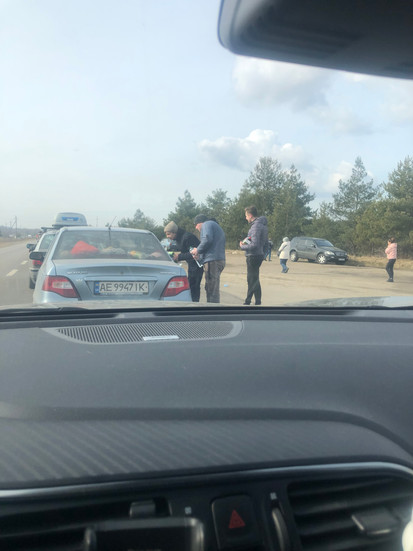
The line of cars stretched to the horizon. After an hour, two, or even three, we had moved just a few meters. Many cars started going into the oncoming lane. In one town, we stood for three hours. The sun was shining brightly. People got out of their cars, met each other, fed their pets, and played with their children. All the gas stations and shops were overcrowded or closed, despite the fact that there was hardly any food or water.
I called my friends, who virtually hugged me, my ex-husband, who kept insisting I was going to the wrong place and doing all the wrong things, and colleagues who had already left for Lviv by bus.
My mother was walking with my children, whose patience was wearing thin from being in the car all the time.
I also got out and leaned against the driver’s door. There were so many cars coming from the border. I decided to stop one of them and ask why they were coming back. The first car I stopped had a local resident in it. He said he wasn’t returning anywhere; he was simply living here.
I felt ashamed.
I realized how I must have looked — a crazy refugee stopping cars and asking weird questions. I decided not to ask anyone anything more, and just keep moving forward, as I had planned.
I stood there, trying to enjoy the sun.
Suddenly, a car stopped and parked on the other side. The window rolled down, and I saw my friend’s husband. I couldn’t believe my eyes and froze in place.
He called out to me.
I ran up, hugged him, and kissed him like crazy. I asked how he was there, and then, of course, I understood — he had brought his wife and children further to the border and was just returning.
I cried uncontrollably, screamed at him to take care of himself, asked him to promise not to go anywhere, and said some other emotional things. He wept too and kept repeating,
“Damn, Olya, how is it? Olya, how is it?”
And I couldn’t answer. The radio in his car was very loud. They were reporting on casualties and explosions.
I made the sign of the cross over him, kissed him, and he drove off.
I cried for a long time, and the people in the cars nearby looked at me with empathy.
I tried to calm my hysteria with a silly explanation that my children are 7 and 9, and that I should be happy about that.
That I’m not married, which means I don't have to break my heart making a tough choice between saving my kids or staying with my husband. That my task is to calm down and remember one thing: I must save the kids, and that’s all I should worry about.
I tried to keep my thoughts apart, but everything got mixed up anyway.
I howled, heartbroken, for everything and everyone.
I didn’t count the number of panic attacks on the road, I didn’t record the names of the settlements we passed, I didn’t count the kilometers.
It was a kind of denial. Despite doing real practical things, I couldn’t believe in their real reason.
My mind protected itself, as I — the only pilot in this “not full” family, according to social norms — should remain level-headed and sane.
So, I didn’t want to write down the names of the places we passed. I didn’t want to acknowledge the obviousness of the obvious.
Each city, each kilometer with a name and geolocation, moving me further from my home, my friends, and my homeland, was another stigma on my soul.
We were moving very slowly. There were no washrooms or shops around. There were no regulations or rules. People walked along the roads, into the fields, or into the bushes. When we reached some inhabited areas, some of us asked locals if we could use their washrooms and wash our hands. Of course, we were all welcomed.
I was one of them.
In another huge jam, I ran to one of the houses to wash my hands. The friendly woman who stood at the door was clearly expecting me. She opened the gate to her house. I was in a hurry because at any moment our turn might come, and that meant the cars behind me could overtake me. While I was in the washroom for just a minute, she and her husband made sandwiches for me and gave me four cups of cocoa. The TV was on in the kitchen, with Zelensky speaking. They asked where I was coming from, hugged me, and, overwhelmed with care and kindness, I ran back through the garden to my car, burning my fingers on the hot cocoa.
Ahead of us was our next overnight stay in the car.
To be continued…







*Ukrainian Nationwide Gas Station Network.